
Catching Youth Before Crisis Takes Hold: YSB’s Shelter Diversion Program
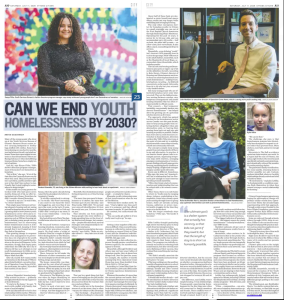
YSB’s Shelter Diversion Program was recently featured in a major Ottawa Citizen investigation into youth homelessness in our city. Here’s what the piece revealed and what it means for our work.
Most young people who arrive at YSB’s Downtown Drop-In on Besserer Street carrying a backpack or a hockey bag stuffed with clothes don’t think of themselves as homeless. Not at first.
That’s one of the central findings in a recent Ottawa Citizen feature on youth homelessness in Ottawa, which included extensive interviews with our Shelter Diversion Case Manager, Kenya Fithe, and our CEO, Nina Gorka.
The gap between “unstable” and “homeless”
There’s a space between not having adequate housing and actually seeing yourself as homeless, and that gap sits at the heart of a real shift in how Ottawa’s youth sector responds to this issue.
Kenya described one young person who’d spent seven months living out of his car. Even then, he didn’t consider himself homeless: “I stayed in my car,” he told her, “so I wasn’t homeless.”
As Nina explained, the longer someone stays in homelessness or shelter, the more that becomes part of their identity, not just how they see themselves, but how the world, and the services meant to help them, see them too. That’s why so much of our work focuses on catching instability before it gets there.
The scale of the problem
Between 1,200 and 1,400 young people experience homelessness in Ottawa every year, according to United Way East Ontario. YSB operates two youth shelters totalling 64 beds, roughly half of them transitional spaces rather than emergency capacity.
Shelters built for short-term emergencies have increasingly become long-term spaces, leaving little room for youth arriving in true crisis. Many who are effectively homeless never show up in official counts at all. That reality has driven the growing use of an approach known as diversion.
What diversion actually looks like
Diversion aims to keep young people from entering the shelter system when a safe alternative exists, or move them back into stable housing quickly. Diversion workers like Kenya intervene at the point of crisis, while connections to family, school, and community still exist.
In practice, that can mean a call to an estranged parent, a temporary stay with relatives, two weeks of rent covered, or a mediated conflict. As Kenya put it, the underlying issue often isn’t housing at all, it’s “a lack of communication and understanding that can be solved with a 30-minute conversation.”
Not every situation is that simple. Some young people are escaping abuse or exploitation, with no safe home to return to. But wherever family or community ties are still intact, diversion gives us a real chance to keep a young person out of the shelter system altogether.
Why family matters
One finding keeps surfacing across the sector: family breakdown is the single biggest driver of youth homelessness. As Nina told the Citizen, it’s “the biggest reason for youth homelessness.”
That’s why diversion leans so heavily on relationships, not just housing outcomes. The goal isn’t always reunification; for some young people, returning home isn’t safe. But wherever a healthy relationship exists, our work is to build on it before that connection is lost.
What it will take
Diversion works, but it isn’t resourced to work at the scale Ottawa needs. YSB’s success rate currently sits around 30%, achieved with a single diversion position. In Niagara, where a comparable program is fully resourced, success rates reach almost 70%.
During a recent six-month pilot, YSB had to turn away roughly 200 young people simply because there was no room. The sector already knows what works. What’s missing isn’t a new idea, it’s the capacity to deliver it at scale.
How you can help
Ottawa has set a goal of ending youth homelessness by 2030. Reaching it won’t require inventing something new, it will require investing in what’s already proven to work.
You can help make that possible:
- Learn more about YSB’s Shelter Diversion Program →
- Donate to support diversion and prevention work →
- Read the full Ottawa Citizen feature →
Thank you to the Ottawa Citizen for its thoughtful, in-depth coverage of youth homelessness in our city, and to Kenya Fithe and Nina Gorka for sharing their insight and experience with the reporting team.